CHIVA Treatment of Refractory Venous Leg Ulcer in a 92-Year-Old Female: A Case Report
Main Article Content
Keywords
CHIVA, venous leg ulcer, case report, nonagenarian, varicose veins, CEAP C6, saphenofemoral junction reflux
Abstract
Background: Venous leg ulcers (VLU) in extreme elderly patients pose significant therapeutic challenges. Conventional surgical approaches carry elevated perioperative risks, and skin grafting without correcting underlying venous hypertension frequently fails. The CHIVA (Cure Conservative et Hémodynamique de l'Insuffisance Veineuse en Ambulatoire) strategy offers a hemodynamically targeted, minimally invasive alternative. We present a case of a 92-year-old female with refractory VLU successfully treated with the CHIVA strategy combined with wound debridement and compression therapy.
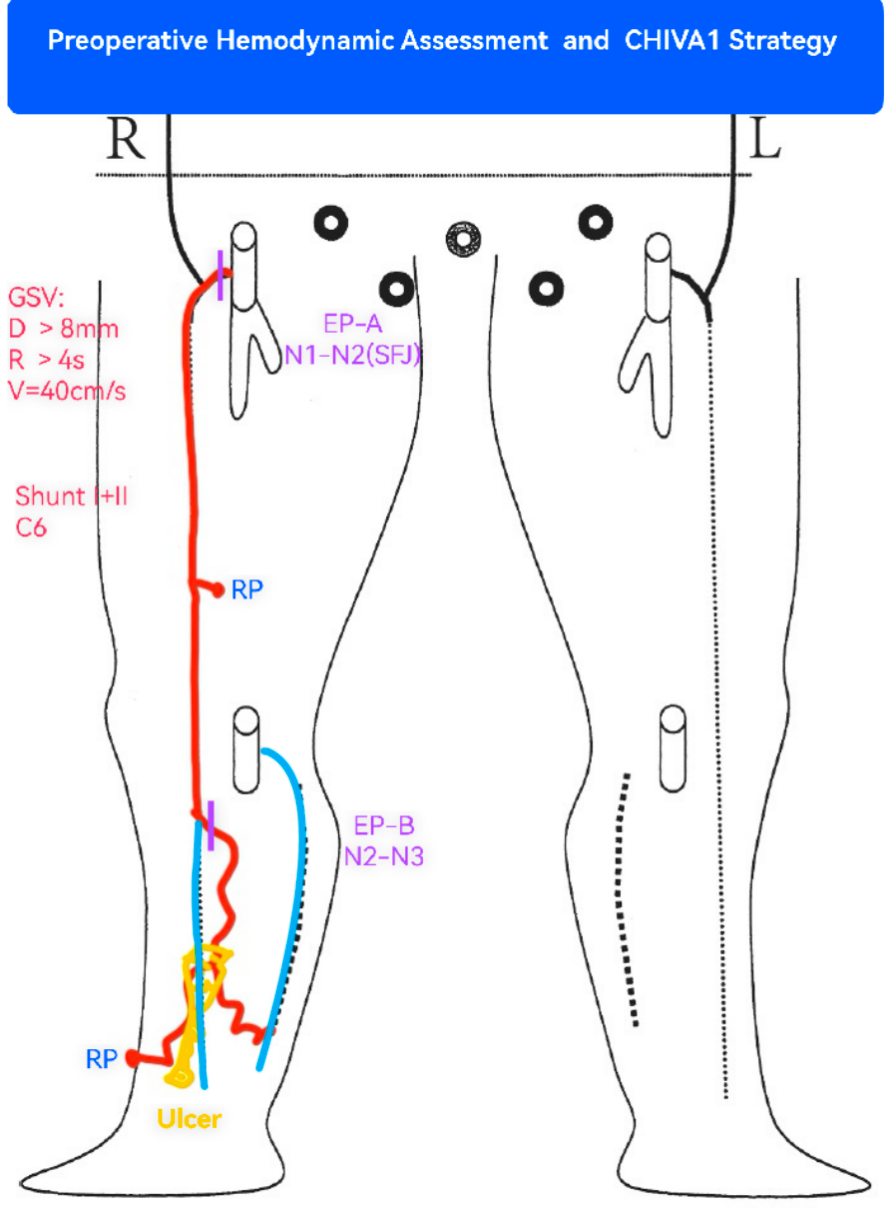
Case Presentation: A 92-year-old Chinese female with a 30-year history of varicose veins presented with a 2-year history of recurrent right malleolar ulcers (CEAP classification: C6). Prior treatments included multiple failed skin grafts at a local hospital and subsequent home-based wound care. Hemodynamic assessment revealed a great saphenous vein (GSV) diameter of 8 mm, reflux time >4 seconds at the saphenofemoral junction (SFJ), and a mixed Franceschi shunt type I+II pattern. The patient underwent the CHIVA1 strategy under local anesthesia, consisting of high ligation at the SFJ (blocking the N1→N2 escape point) and ligation of the N2→N3 escape point at the lower leg, with preservation of the GSV. Concurrent wound debridement and elastic compression bandage therapy were applied. Two weeks postoperatively, the ulcer had essentially healed, edema resolved, and the Venous Clinical Severity Score (VCSS) decreased from 16 to 6. At 6-month follow-up, the ulcer showed no recurrence.
Conclusion: This case demonstrates that the CHIVA strategy—a hemodynamically guided, minimally invasive approach performed under local anesthesia—can be safely and effectively applied in nonagenarians with refractory VLU. Addressing the underlying venous hemodynamic pathology, rather than treating the ulcer in isolation, is critical for sustained healing. The CHIVA approach may represent an optimal treatment paradigm for extreme elderly patients with C6 chronic venous disease who are poor candidates for conventional surgery or thermal ablation under general or spinal anesthesia.